Aftermath of the Sydney Test

The SCG witnessed the most disgraceful on the field behavior by the Aussies. As predicted Steve Bucknor swung into action along with Benson to destroy a Test match in its entirety.

There is plenty on the web about the events as they unfold. Here are a few of the good ones I have come across.

Is it a gentleman’s game?

Why Ponting should be banned

Ponting must be fired

Competitive fire often heats things out of proportion

Rotten from the first day to the last

Death by Umpiring

My favorite is the one calling for Ponting’s firing followed by the one calling for his ban. Before Ponting became captain there were concerns about his behavior (character) after he was involved in a drunken brawl or two. His behavior in this Test and those of his team mates (inspired by him of course) confirms that the man still has the same behavioral issues. In fact, he had the gall to insult the media after the match.

If the Aussies care about gaining the respect and admiration (!!) of the world for their cricket, it would make sense to heed Peter Roebuck’s call.

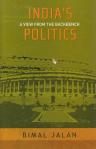
Book Review: India’s Politics

Title: India’s Politics — A View From The Backbench
Author: Dr. Bimal Jalan

The author was the former head of Reserve Bank and then went on to become a Rajya Sabha MP.
The underlying theme of the book is that coalition Governments at the center are here to stay. This trend brings with it its own set of issues and if not addressed soon enough could result in further deterioration of the political system as whole and hurt the country and its standing in the world in general. The author is careful not to mention any individuals per se despite discussing specific issues and events. In other words, the book is more about the political system in India rather than about personalities. The book discusses the challenges of India’s current political system and offers a reform agenda.

Here are a few (but by no means all) of the points raised in the book.

Coalition Governments: Given that coalition governments are here to stay, the author calls for coalition partners to agree on a common set of social and economic policies rather than enter into an opportunistic arrangement of convenience. The author argues that these smaller entities must be considered as part of the coalition (UPA, NDA etc.) and not as separate parties for the business of parliament. Any differences must be sorted out within the entity as opposed to in public.

Collective Responsibility: The Indian constitution was based on the principle of collective responsibility of the council of ministers. This principle shields individual ministers from being held accountable for their performance while it has not prevented them from taking decisions without seeking a minimum consensus from coalition partners. The author provides examples to illustrate this phenomenon.

Anti-Defection Law: Coalition governments have resulted in small parties with less than 5% of the national votes wielding unusual power. They even control ministries by virtue of their being part of the ruling coalition, but with little accountability. The author suggests that the anti-defection bill must be amended to disqualify members of a party with less than 10-15% of the seats in the Lok Sabha who opt to join a coalition and then defect.

Business of Parliament: The last few budgets have been passed without discussion! The author says its imperative to bring in a rule that you can’t pass the budget with a voice vote.
Inefficiency: There is too much inefficiency in public services. There are way too many agencies, schemes, departments etc (created by different ministries) often working at cross purposes and politicization of administration in general (“In recent year, the politicization of the bureaucracy has gathered further momentum as a result of governments with shorter tenures pursuing their private or party interests in the guise of promoting the larger public good”). Ultimately, these inefficiencies affect the poorer sections of the society and contribute towards increasing the disparity between the rich and the poor.
Security/Law and Order: The national boundaries and the armed forces are the responsibility of the central government, the responsibility of internal law and order is the responsibility of the state. The states unfortunately are increasingly becoming incapable of addressing law and order issues. (“One-third of all Indian districts are now believed to be under the influence of Naxalite organizations”). Ministers in power in the state tend to control and interfere in the administration of law and order. The authors recommendation is to redefine India’s overall security and law and order management with a greater control and co-ordination from the center especially to respond to terrorist threats orchestrated by external organizations which have a global reach.
A well written book, that is a must read for anyone interested in India’s politics today and into the future. I found that the book tended to get repetitive at times. Perhaps, the author was doing this for emphasis sake. There was no mention of the events at Godhra in 2002 and how events like this can be avoided, which was a disappointment. But overall a very informative book from someone well versed in India’s economics, politics and everyday challenges.

Sydney Test: Umpiring and Weather Hold the Key

The last day of the Sydney Cricket Test match between India and Australia is interestingly poised with Australia having slight edge. Given the present state of the game, the three possible results (An Aussie victory, a draw and an Indian victory) will depend significantly on umpiring decisions and the weather n the final day. If the weather intervenes in a big way, a draw is more or less certain. On the other hand, given the performance of the umpires in this Test and Steve Bucknor’s poor track record while umpiring against India, I suspect umpiring could play a significant role on the final day. A couple of bad decisions against India and Australia will have this match in the bag.
Michael Clarke — Disgraceful

On the fourth day, a caught behind (Hayden) and an lbw decision (Hussey) that went against India on day 4, virtually destroyed India’s chances of gaining the upper hand. This is in no way meant to take away credit from both these batsmen who fought it out in the middle to make every run unlike the conventional Aussie attack style of batsmanship. A perfect example of how much umpiring holds the key was reflected in Michael Clarke’s disgraceful decision not to walk after being caught in the slips by Dravid. “If umpires make mistakes so often maybe I can get away” seems to be the mindset of today’s international players.

India Missed Murali Karthik

While India’s two spinners did a fine job, India definitely missed a third spinner in this Test. Murali Karthik would have been a terrific asset in this match. Without Zaheer Khan in the team, Kumble had no where to turn for a wicket taking bowler. Ishant Sharma appears to be a surprise back up fast bowler. His fielding is not the best and he is definitely not quick, for a player so early in his career. There is no question that India is missing Sreesanth’s pace and exuberance on this tour. Taking the second new ball has become such a painful decision. Thankfully RP Singh has done well so far and seems to have great potential for the future.

SCG Highlight: India’s Fight Back

The highlight of this Test thus far has been India’s impressive fight back after the MCG debacle. For the first time in a very long time, Australia were at the receiving end in a Test match. In fact, the Aussies were under pressure and never really dominated this Test match. And if they ever did, I dare say, that it was with ample assistance from the umpires (read decisions in favor of Symonds). The batting failure at the MCG justifies the need for more practice games before a Test match on foreign soil, especially against a formidable opposition like Australia. Unlike at MCG, almost every Indian batsman barring the young turks (Dhoni and Yuvi) put in a great performance. Sachin’s century was brilliant, VVS was sublime, Dravid was determined and Dada was smooth (not to mention the fighting spirit of the tail-enders). It will be a pity if all this good work crumbles on the last day, particularly if it is helped along by Bucknor and co.

Obama Victory Speech At His Headquarters in Iowa

http://youtube.com/v/6KjEdTMLtDk

Check out Obama’s cool victory speech. Wonder who is speech writer is?

There is no question that this is a historic moment in American politics where a predominantly white state has voted resoundingly in favor of an African American. It might just be a start, but a start nevertheless.

Book Review: No God in Sight

Title: No God in Sight
Author: Altaf Tyrewala

The author deserves credit for taking an interesting approach — Each chapter is written in the first person for a different character in the story. All characters in the book are based in Mumbai and it is a good reflection of the variety of people in the city and their daily lives.

The book starts promisingly but unfortunately, it does not quite come together in the end. This was rather disappointing. The title of the book is hardly explored anywhere in the book and just receives a passing mention in a couple of places. This is the author’s first book and he seems to have made a decent start despite the shortcomings mentioned earlier.

Movie Review: Taare Zameen Par

Title: Taare Zameen Par
Starring: Amir Khan and a bunch of newcomers
Director: Amir Khan

The movie is about a kid affected by dyslexia and how his family and school deal with it. Amir Khan is a teacher at the school who identifies the problem and ensures that all and sundry work together to transform the kids life. This in short is the story line of the film.

The theme is certainly new and Amir Khan deserves credit for experimenting with a new topic. This is one of those rare Hindi films that you can watch with the kids since it is sans the usual Bollywood masala.

Amir Khan appears to have gone completely low budget. There is not a single familiar face in the film besides himself! The songs in the film are unnecessary and don’t quite fit in. The film tends to get preachy (reminded me of the tone of the film Swades) at times. Parts of the film are really slow and could certainly have been “speeded up”. Amir Khan the teacher confronts parents and lectures them about not pushing kids to excel. It would have made a lot of sense to explore and discuss the issue (like Amitabh and Om Puri discuss communal tensions in Dev) in as much detail as possible because in reality it is easier said than done. Also, it might have been far more powerful if the teacher’s past had been explained in greater detail. How did it work for him? How did he adjust to growing up with dyslexia?

Darsheel Safary, the child actor who plays the lead role as Ishaan Awasthi has put in a fine performance. The Director has done well to capture his emotions even with minimal dialogues. For a directorial debut, Amir Khan has certainly done well despite the weaknesses in the film. While by no means a “must see” film, it is certainly watchable.

Sydney Test: Batting Order Still a Challenge

The decision not to play Virender Sehwag in the second Test is a clear sign that the Indian think tank is not ready to abandon its team combination as yet. This might be a sound decision given Sehwag’s extended poor form. If its a toss up between Dravid’s return to form and the chances of Viru clicking as opener, the choice should be obvious.

Open with Sachin (or Dada)

L. Siva recently suggested that perhaps Sachin should open the innings ahead of Dravid. It might be a worthwhile strategy given that he is clearly in good touch. In fact, Ganguly might not be a bad bet at the top of the order either. Dravid can then swap positions with whoever steps to the top, since VVS appeared to be very comfortable at number three. Its best to lead with the men in form rather than pressurize those who are struggling to deliver.

Pathan for Yuvraj?

The other worrisome factor (that appears to have been overlooked) for India is the failure of Yuvraj Singh in both innings of the first Test. Yuvraj has always had problems facing Hogg (and Muralitharan). He was out to Hogg in the second innings and was lucky not to be given out to a bat-pad catch in the first. Given that he bats low down the order, he is likely to face Hogg very early in his innings. This would be a serious challenge for him to overcome. Given this scenario, Irfan Pathan might be a better bet for Yuvraj’s spot, especially if Zaheer misses out because of injury. This will mean five bowlers, and an equally good batting line up, at least on paper.

My guess however, is that India will play the same team with Dravid as opener for this Test at Sydney. If it fails again the third Test will see significant changes.

The Crisis in Pakistan

Just when it looked like Pakistan was returning to normalcy after President Musharraf lifted the emergency, it appears to have landed in a crisis. Sad to hear of the assassination of Benazir Bhutto, the most visible and relatively progressive face of Pakistani politics. It is hard to imagine (yet impossible to rule out) that the army had played a role in Ms. Bhutto’s death. In a highly populated country like Pakistan its virtually impossible to protect a leader who thrives on waving to the masses from an open car top. Ms. Bhutto took some unnecessary risks and unfortunately paid the price.

The immediate question that comes to mind is clearly, What next? Where does Pakistan go from here?

  • President Musharraf can now claim that his Emergency rule was justified given the law and order situation. In short, he could tell President Bush & team, “I told you so”, thereby countering any cutbacks in the funding from the US.
  • Nawaz Sharief, the other political force in Pakistan must now be terrified to campaign. The election will most likely be postponed, but a fair and free election seems unlikely anytime soon.
  • The Bhutto family decision to continue its hold on power is not surprising, but it remains to be seem if this is viable in the long term. Sadly, this is likely to stunt the rise of any new leadership.

With President Musharraf no longer army chief and the country clearly in a crisis, with control on the purse strings, the US is clearly in a position to call the shots in Pakistan, more so than ever before. As a start, it would be best if the US demanded greater transparency in return for continued funding with a not too long term commitment to transition Pakistan to a democratically elected government. This is easier said than done, but a firm long term US policy on Pakistan (with or without Musharraf) is long overdue. The current criss might be the perfect opportunity to develop and execute on a new long term strategy.

Ind-Aus Test Match: Exciting Day 1

Over three hundred runs, the Aussies almost all out, a superb display of spin bowling by Kumble, a brilliant delivery from Zaheer Khan to get rid of Ponting, a fine century by Hayden, and some good catching by India sums up the first days play.

The biggest open question at this point is whether India can live up to its reputation of having some of the best batsmen in Test cricket in its ranks. After restricting Australia, if India can responds with a fighting total, this should make an exciting Test match. For the first time in a long time, Australia will be on the back foot, provided India can respond with a fighting total.

India’s weak link in the bowling department was Harbhajan Singh. He never really looked like taking a wicket. If India has to perform well on this tour, he will need to turn in a good performance.

On the batting front, India will be better off opening with Sachin (based on current form) as suggested by L. Siva. This will surprise the Aussies and take some pressure off Dravid, who seems to be struggling for form. The other wild card might be to open with Ganguly. In any case, the move to include Yuvraj in the eleven is a terrific move and should strengthen the middle order substantially.

Hillary Clinton: Poor Strategy In Fighting “Change”

Senator Obama has clung on to the theme of “change” and seems to be clearly working in his favor. The reasons are simple. He hardly has a record to criticize or find fault with in Washington. On the most important issue of the Iraq war he has been steadfast in his opposition from the very beginning. So, given the poor opinion poll ratings of Congress and the President himself, Obama surely has a strong case for change. Besides, it is easy to brand Hillary’s 35-years of experience claim as being part of the Washington establishment that needs change, thereby bolstering his case for change.

Hillary and her team have been fighting Obama’s change theme quite poorly. Bill Clinton struggles hard to position her as the “agent of change“. She herself says that this election is not about choosing “change over experience”and in the very same ad she talks about why her experience can bring about change, sounding rather defensive. By stating that this election is not about choosing change over experience she is making this election precisely about that!

Ironically, Senator Obama is drawing heavily from Bill Clinton’s strategy in 1992 where he positioned himself as the candidate of change while his opponent George Bush Sr. stood for experience. In fact, Bill Clinton argued then about the right kind of experience and the wrong kind of experience referring to the same old Washington way of doing things. The big difference though was that Bill Clinton had the experience of having been Governor in Arkansas and backed up his claim by touting his track record.

Perhaps Hillary Clinton’s best possible response to this might be to accept that Senator Obama has a good story to tell on the change front. She should go to the extent of stating that her husband come to power using precisely this theme. However, she and her husband soon realized that change in Washington is easier said than done. There is a learning curve involved in bringing about change in Washington and she has first hand experience of facing the challenges of attempting to bring about change. This would clearly be a much more creditable and genuine argument as opposed to touting her questionable 35-years of experience.

Its hard to imagine that a master strategist like Bill Clinton and all the high-priced consultants on the Hillary campaign are unable to work up a better strategy. In fact, Bill Clinton lost a golden opportunity on the Charlie Rose show to accept that the change theme works but has a learning curve involved once you get to Washington.